
The Run mutates the proposition yet again. This time, the development team is Black Box, the veterans now integrated into EA's vast Vancouver office. Previously responsible for the epic, narrative-driven Need For Speed Undercover titles, the studio has stuck with the idea of a racing game driven by an underlying plot. But The Run takes this concept to a new level. It is essentially a cinematic action adventure game, based around driving. It is Uncharted on four wheels.
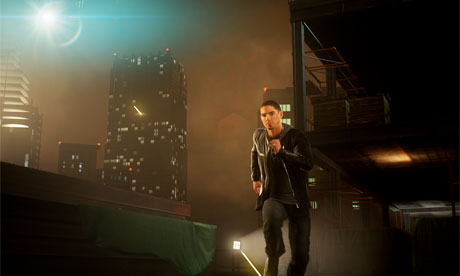 Players take on the role of Jack (he doesn't seem to have a surname at the moment), a talented driver who gets involved in "an illicit high stakes race" from San Francisco to New York. We don't know much about the character yet, but he's got a shady history, and it seems he's on the run from somebody – the police? Gangsters? Both? EA isn't saying just yet. The game, then, is a gigantic chase sequence, taking in several cities and landmarks across the country. It's the first title in the series to use real locations, though these are highly stylised interpretations. There is no slavish adherence to grid-based city road layouts here.
Intriguingly, Need for Speed: The Run will be one of the first console titles to use DICE's cutting-edge Frostbite 2 engine. It has apparently taken a year to re-purpose the tech for driving rather than shooting, but according to designer Alex Grimbley (recently head-hunted from Codemasters where he oversaw the Grid and Dirt titles), it's been worth every moment. "Frostbite is awesome for quick iteration," he explains. "Previously, if a producer requested a change to a track, it would sometimes take a day for that change to get in the game and be playable. We can do it in minutes now. So rather than making one change to a track per day, we can get up to 30 changes in."
 The design process, then, has been one of experimentation and refinement. On previous Black Box titles, artists, coders and designers all worked separately. On The Run, they're working collaboratively in small groups building the game together from initial planning to structure and development. It has created a much more improvisational feel. "Previously the art guys would build their tracks, then they'd throw them over, and the designers would go 'oh well, that's really not much fun, can you change it?'" explains Grimbley. "Obviously that was a horrible process – it didn't really allow for iteration, and it didn't allow for quality. Now we all get in a room together, we brainstorm, we throw stuff up on the wall, and slowly the game evolves."
But there are other more tangible benefits to the Frostbite 2 engine. As the executive producer at EA, Jason DeLong, explains: "Frostbite gives us some of the greatest world destruction that you've seen. We have an action driving experience that's never been done in NFS. It's a racing game at its core, but this engine has allowed us to push the narrative further than ever before. Also, the actor animation in Frostbite 2 is incredible, which is really important for us, because, for the first time in NFS history, you're going to get out of the car …"
 And here's the key talking point at the moment. At certain moments through the game, Jack will head off on foot. For the most part, these short, intense and crucially interactive sections will work instead of pre-rendered sequences to move the story along.
"Our original question was, how do we keep the player immersed in the game while we're telling the story?" says Steve Anthony, the producer of the in-car content. "In Most Wanted it was very much a movie, but games are moving beyond that – storytelling is gameplay."
Apparently, the original idea was to offer the player full control over the character in these onfoot challenges. "It was a freeform system," explains Anthony. "The character could get out and explore the world. But through focus tests and playing ourselves we quickly discovered that once you do that, the player wants to go everywhere – and we're Need for Speed, it's a driving game. Plus we didn't want to invest a full year building a full locomotion system. Now, it's in a more controlled setting."
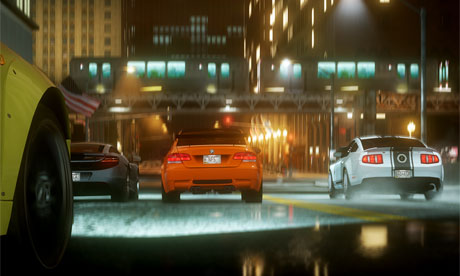 What that looks like in practice, is a series of on rails action moments controlled via a quick-time event mechanism. In the demo I played, taking place in downtown Chicago, I start off competing against seven other cars in a race through the night-time streets, but after a few minutes, a car comes scorching out over a junction and drives straight into me. My vehicle is a write-off, so Jack jumps out, and then spots several armed men running toward him. He legs it into a building, up several flights of stairs and then bursts out onto a rooftop. It's at this point that the interactivity kicks in. A screen prompt gets me to hit X repeatedly to start Jack running toward a ledge then the Triangle button triggers a leap onto an adjacent tenement. All the while, a helicopter hovers overhead, spraying machine gun fire.
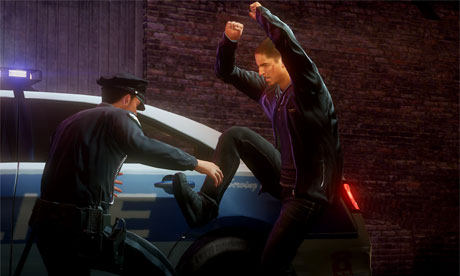
  Eventually, Jack clambers down a fire escape and finds himself in an alley, with a police car just pulling up nearby. He runs at one of the cops and a Triangle prompt comes up – get the timing right and Jack performs a flying kick at the policeman, then gets inside the car and drives off. Now, we're back in control, with a timer ticking down and a directive to get the hell out of town. With the helicopter in, ahem, hot pursuit, I need to snake in and out of the traffic, looking for cover in a series of underpasses. It's thrilling stuff, and classic Need for Speed. The sequence ends with my car unavoidably swerving to avoid a jackknifed oil truck, then busting through a wall and landing upside down on a railway track. In a moment highly reminiscent of a scene in Heavy Rain, I now need to look around and figure out which of the available button inputs will allow me to kick out the windows and escape before being hit by an incoming train.
These events won't always be about harsh success or failure states. In some sections there are branching outcomes, so if the player mangles a certain button press, they'll get another chance to pull through. In the alleyway police fight, for example, if the kick is poorly timed, the cop grabs Jack and gets him in a choke hold, but then there's a chance to hit a button, fight back, and steal the car.

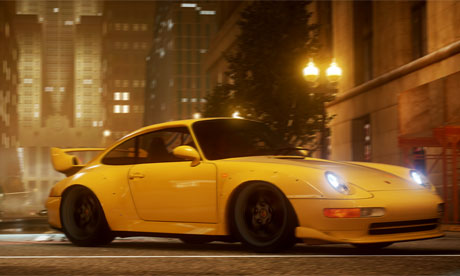
Away from all that, are the standard concerns for a driving sim. The Run employs a large range of real-world vehicles, seemingly taking in the usual mix of muscle cars, street racers and refined exotics. For the handling mechanic, Black Box is going for another hybrid approach. "We're trying to sit somewhere between Shift and Hot Pursuit," says Grimbley. "We want to reward sim fans like myself – I don't want be bored in 10 minutes, I want there to be some depth to the handling. I want to re-lay the tracks and knock a few seconds off my time. But at the same time all our art director wants to do is power-slide through every track. So we're trying to appeal to both sets of fans. We're trying to meet the players' perception of how these cars will feel, we're not over-investing in replicating exact performance stats."

The Run is an intriguing proposition, and the idea of scorching through the States in a Shelby is extremely enticing – it trades on the fantasy many of us harbour, of heading out on a Hunter Thompson-esque road trip across America. Purists will complain about the onfoot sequences, and sim nuts will balk that you don't get to drive between Frisco and the Big Apple. But there are over 300km of track, three times more than Hot Pursuit, so there's plenty to see. Launching into a very dense driving genre, Black Box has gone all-out to create something that stands apart. We'll have to wait and see whether this is necessarily a good thing.

No comments:
Post a Comment